
Ultimate Guide to Worship Team Vision and Mission
Struggling to keep your worship team aligned and motivated? A clear vision and mission can transform your ministry by providing direction, purpose, and unity. Here’s what you need to know:
- Vision Statement: Defines your future goals – your "destination."
- Mission Statement: Outlines your current purpose – your "why."
- Core Values: Principles like unity and preparation that guide daily actions.
This guide helps you create and implement statements that inspire your team, simplify decisions, and align with your church’s goals. Start with prayer, identify your purpose, and craft concise, actionable statements. Keep them alive by integrating them into rehearsals, decisions, and team culture. A shared vision isn’t just a statement – it’s a foundation for lasting impact.
The Difference btw PURPOSE, VISION, and MISSION For Your Worship Ministry! (and I need your HELP!!!)
sbb-itb-5a6b344
What Are Vision and Mission Statements?
Vision and mission statements play distinct but complementary roles. A vision statement describes the future you aim to achieve, while a mission statement defines your current purpose. Think of the vision as your ultimate destination and the mission as the driving force behind your journey.
Worship leader John White offers this perspective on vision:
"Godly vision is a compelling image of a better future that goes beyond our abilities and available resources that is empowered and directed by God".
A vision should stretch beyond what seems immediately possible, relying on faith and divine guidance to bring it to life.
On the other hand, a mission statement serves as a practical guide for daily decisions. It answers essential "why" questions: Why does your team rehearse? Why do you select certain songs? Why are you accountable to church leadership? While your vision focuses on what lies ahead, your mission keeps you grounded in the present.
Let’s break down these components further.
Vision Statements Explained
A vision statement outlines the future reality you want to create through your worship ministry. It should be specific and measurable, offering a clear picture of success. For instance, instead of a vague goal like "improve worship", you could aim for something concrete, such as increasing the percentage of your congregation that arrives early for worship by 25%, or praying for 25 people to commit their lives to Christ within a year through the worship experience alone.
Specificity and measurability are what transform a vision from an inspiring idea into a roadmap for action. A well-crafted vision motivates your team because it provides clarity and direction. Following the advice in Habakkuk 2:2, "Write the vision; make it plain", ensures your team understands exactly where they’re headed and can actively work toward that goal.
Mission Statements Explained
Your mission statement defines who you are and what you do right now. It should be brief – ideally one or two sentences – and easy for your team to remember. This statement reflects your current purpose and serves as a practical tool for guiding decisions and actions.
Take this example from City Life Worship:
"City Life Worship exists to passionately lead our congregation into transformative worship encounters by skillfully blending contemporary and traditional church music, fostering a welcoming and vibrant atmosphere where lives are changed while we offer up our best praise to Jesus Christ".
This mission statement clearly identifies their focus (the congregation), their method (blending musical styles), and their desired result (transformed lives). It’s concise yet comprehensive.
To craft your own mission statement, follow a simple formula:
"[Team Name] exists to [verb] [target audience] by [action], creating a [descriptor] experience that [desired outcome]". This approach ensures your statement includes all the key components while remaining straightforward and actionable.
Core Values That Guide Your Worship Team
Core values anchor your worship team’s vision and mission, shaping every decision and interaction.
Defining Your Team’s Core Values
Core values are the principles that your worship team holds as non-negotiable. They influence everything – from how you choose songs to how you welcome new members and connect with your congregation. Tim Price, Director of Worship Arts, puts it well: “When your values are clear, your choices are easy”.
Take excellence, for example. It’s not about being perfect or competing with others – it’s about making the most of your resources and talents. You see this in small, practical ways: showing up on time for rehearsals, hitting the right notes, projecting lyrics clearly, and being thoroughly prepared. Excellence is about honoring what you’ve been entrusted with.
Then there’s authenticity and unity, which go hand in hand. Authenticity means worshiping with genuine devotion, not just putting on a performance. Unity fosters teamwork and a shared purpose, creating a space where everyone feels connected. Add servanthood to the mix, and you have a team that embraces humility, focusing on serving the congregation rather than seeking the spotlight.
A standout value for many worship teams is fostering “A Singing Church.” This means prioritizing congregational participation. For instance, if the congregation can’t hear themselves sing, it might be time to adjust the sound mix or volume. This value ensures that worship remains a shared experience, not just something to watch.
By defining these values, your team creates a strong foundation that influences every aspect of your ministry.
Connecting Values to Daily Practice
Core values aren’t just ideas – they need to show up in your team’s daily routines, decisions, and interactions. They’re the lens through which you evaluate song choices, team auditions, and even how you run rehearsals.
Here’s a quick look at how some common core values translate into everyday actions:
| Core Value | Practical Daily Application |
|---|---|
| Excellence | Praying as a team, preparing thoroughly, showing up on time, and ensuring musical accuracy. |
| A Singing Church | Adjusting sound levels so the congregation can hear themselves and ensuring lyrics are clear. |
| People-Focused | Hosting community events, holiday gatherings, shared meals, and prayer circles. |
| Humble Leadership | Responding to praise with gratitude, giving glory to God, and fostering peace and respect. |
These values should also guide your team’s accountability and spiritual growth. For example, new members should fully understand and commit to your vision. This often includes upholding high standards in both personal behavior and spiritual development. Reinforcing these values through team prayers, conversations, and onboarding helps keep everyone aligned.
When your team’s daily actions reflect its core values, you stay grounded in your mission while building a worship experience that truly connects with the congregation.
How to Create Your Vision and Mission Statements
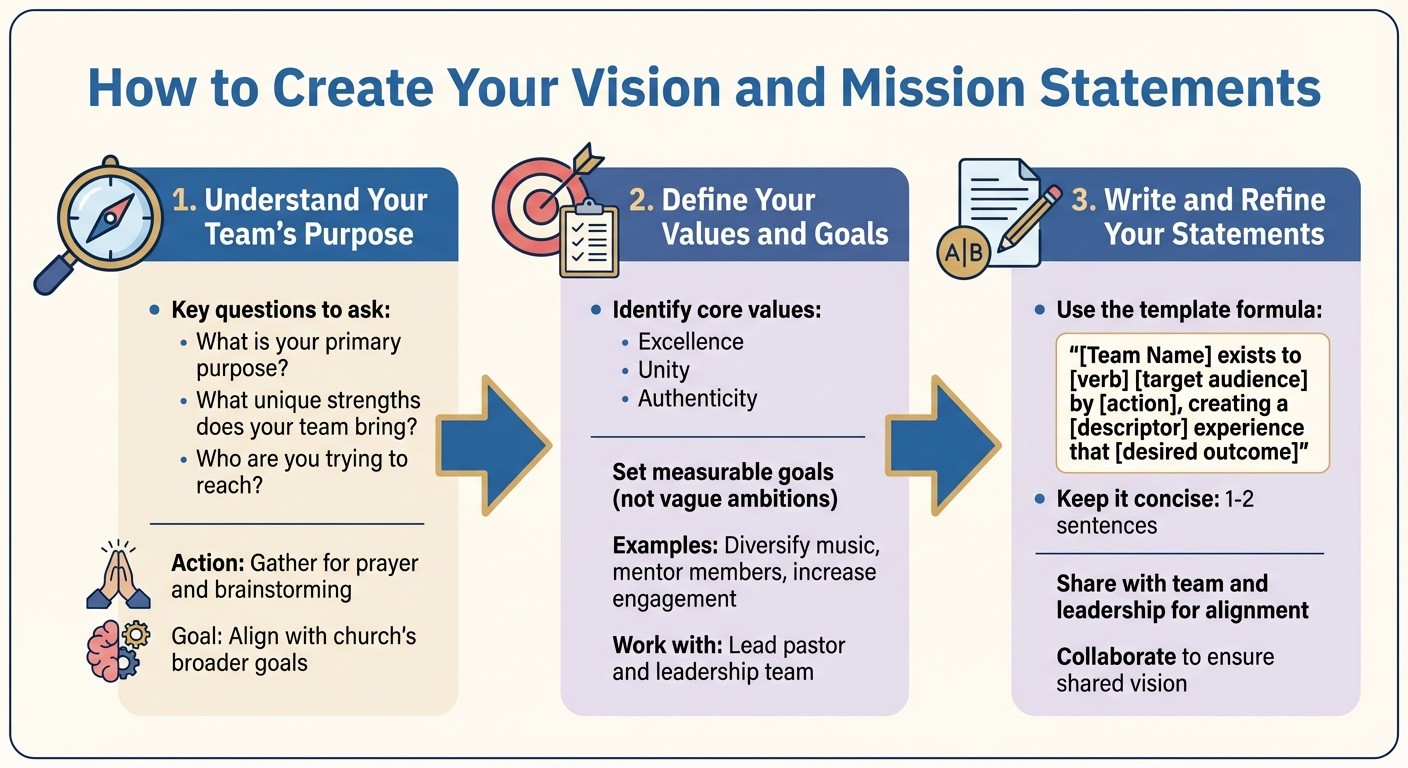
3-Step Process to Create Worship Team Vision and Mission Statements
Start by dedicating time for prayer and thoughtful reflection as you work on crafting clear vision and mission statements. This process thrives on collaboration with your team and church leadership. Think of your mission statement as a compass that keeps your ministry focused and aligned with its overarching goals.
Step 1: Understand Your Team’s Purpose
To begin, ask yourself and your team some core questions: What is your primary purpose? What unique strengths or gifts does your team bring? Who are you trying to reach? These questions will guide your efforts as you gather for prayer and brainstorming to uncover your specific calling.
This isn’t about mimicking what other churches are doing. It’s about understanding why your team exists, why you approach worship in your unique way, and how you stay accountable to your leadership. Make sure your vision aligns with your church’s broader goals, fostering a sense of unity with your pastor and executive leadership.
Once you’re clear on your purpose, the next step is to define the values and actionable goals that will drive your ministry forward.
Step 2: Define Your Values and Goals
With your purpose in mind, identify the core values and specific goals that will shape your ministry. Work closely with your lead pastor or leadership team to establish principles like excellence, unity, or authenticity – values that reflect your church’s theology and identity.
Set clear, measurable goals instead of vague ambitions. For instance, you might aim to diversify your music repertoire with quality accompaniment tracks, mentor emerging team members, or increase congregational engagement during worship. Your mission statement should address the “why,” while your goals focus on the “what” you want to achieve.
After laying the groundwork with purpose and goals, you’re ready to put your vision and mission into words.
Step 3: Write and Refine Your Statements
A helpful template to guide you is: "[Team Name] exists to [verb] [adjective] [target audience] by [action], creating a [descriptor] worship experience that [desired outcome]".
Here’s an example from City Life Worship:
"City Life Worship exists to passionately lead our congregation into transformative worship encounters by skillfully blending contemporary and traditional music, fostering a welcoming and vibrant atmosphere where lives are changed while we offer up our best praise to Jesus Christ".
Aim for a concise, one- or two-sentence statement. Once you’ve drafted it, share it with your team and church leadership to ensure it reflects a shared vision. This collaborative process keeps everyone aligned and focused as your ministry continues to grow.
Putting Your Vision and Mission Into Practice
Your vision and mission statements only make an impact when they’re woven into everyday actions. Vision isn’t just something you state – it’s something you live. It’s easy for teams to lose sight of long-term goals while managing day-to-day tasks, so frequent reminders are essential.
Using Vision and Mission in Daily Activities
Make it a habit to tie your vision and mission to your weekly rehearsals. Set aside time to talk about your team’s core values and how they drive your ministry’s success. For example, emphasize the value of excellence by addressing underpreparedness in one-on-one conversations. Define excellence as “giving your best” instead of “being the best” to help your team avoid burnout.
Your mission statement should guide decisions like song selection and track use, musical style, and even team membership [3, 4]. When auditioning new members, share your vision document to ensure they understand and are ready to commit to it. Keep the team motivated by sending monthly updates through emails or videos to celebrate progress. Hosting quarterly celebrations is another great way to recognize milestones and keep everyone engaged.
For your vision to stay on course, clear and measurable actions are key.
Measuring Progress and Staying on Track
Track progress using both lead behaviors and lag outcomes. Lead measures could include things like team members learning their music before rehearsals, showing up early, or maintaining personal worship routines. Lag measures, on the other hand, might show up in how smoothly services run, positive feedback from the congregation, or the overall quality of worship music.
Set specific, measurable goals instead of vague aspirations. For instance, you could aim for a certain percentage of the congregation to arrive early for worship or set a target for your team to create a specific number of original songs. During regular check-ins, use your mission statement as a guide to ensure everyone is aligned. Additionally, evaluate how well your team collaborates and address any tensions to see if your culture reflects your mission. Combining hard data with a sense of how your team feels gives you a well-rounded view of how effectively you’re living out your vision.
Conclusion
Your vision and mission statements act as a guiding light for your ministry. Worship leader Justin Rizzo puts it perfectly:
"We’re human. We easily forget and lose sight of things. So we need to set the vision, seek to live it out, and remind your team consistently".
To keep your ministry aligned, make it a priority to regularly revisit and reinforce these statements with your team and church leadership. This ongoing dialogue ensures that your worship ministry remains focused, even as circumstances evolve.
Consistency is key. Teach and embody the vision in your daily ministry, and make it a point to review it with new team members. This not only aligns everyone with the same goals but also helps guide decisions. When you involve your team in refining the vision, it fosters a sense of ownership and unity that strengthens your ministry over time. Keep the statements short and impactful – just one or two sentences that are easy to remember and apply.
A clear vision doesn’t just provide direction; it inspires and keeps your team grounded during challenges. By committing to this shared vision, you’ll build a unified team ready to fulfill God’s purpose for your ministry. Let this vision shape a worship experience that truly reflects your mission.
FAQs
How do I keep our vision from becoming “just words”?
To ensure your worship team’s vision doesn’t remain “just words,” make it an active part of your team’s culture. Talk about it regularly during gatherings, sermons, and meetings. Write it down, revisit it frequently, and lead by example so it’s clear in action, not just in theory. Through consistent reminders and purposeful steps, your team can truly embrace the vision and make it a shared mission rather than an empty statement.
What if my team disagrees on our worship direction?
When disagreements come up, it’s important to tackle them head-on in a way that’s open and productive. Clear and respectful communication plays a huge role here – take the time to truly listen to everyone’s point of view with patience and understanding. A shared vision or mission can act as a powerful anchor for the team, helping to align decisions and bring everyone back on the same page. Revisiting the mission statement can serve as a reminder of the team’s common goals and deeper spiritual purpose. Addressing conflicts with honesty and mutual respect not only strengthens relationships but also enhances the team’s ability to lead worship as a united front.
How can I measure worship progress without focusing on performance?
Measuring progress in worship isn’t about achieving technical perfection or gauging visible reactions. Instead, it centers on spiritual growth and fostering a deeper connection with God. True success is reflected in moments of heartfelt worship, acts of obedience to God, and the profound sense of His presence. Taking time to regularly assess the spiritual health of the team and the quality of relationships within it can offer valuable insights. This approach prioritizes authenticity and spiritual depth over external factors like congregation size or levels of engagement.