
Ultimate Guide to Church Choir Leadership
Leading a church choir goes beyond music – it’s about inspiring worship, building community, and nurturing faith. Whether you’re organizing rehearsals, selecting music, or guiding your choir spiritually, effective leadership makes all the difference. Here’s what matters most:
- Communication: Be clear, consistent, and respectful in your directions. Start and end rehearsals on time.
- Energy: Your enthusiasm sets the tone. Arrive prepared and stay engaged.
- Patience: Support every member, regardless of skill level, and adapt to challenges like personal struggles or last-minute changes.
- Rehearsals: Plan ahead with clear goals. Mix warm-ups, new material, and familiar pieces for efficiency. You might also consider using contemporary Christian tracks for choir to keep rehearsals fresh and engaging.
- Music Selection: Choose songs that match your choir’s abilities while keeping worship meaningful.
- Relationships: Build trust by checking in with members, assigning roles, and resolving conflicts promptly.
Your choir is more than a group of singers – it’s a ministry. With thoughtful preparation and care, you can lead them to inspire worship and deepen connections in your congregation.
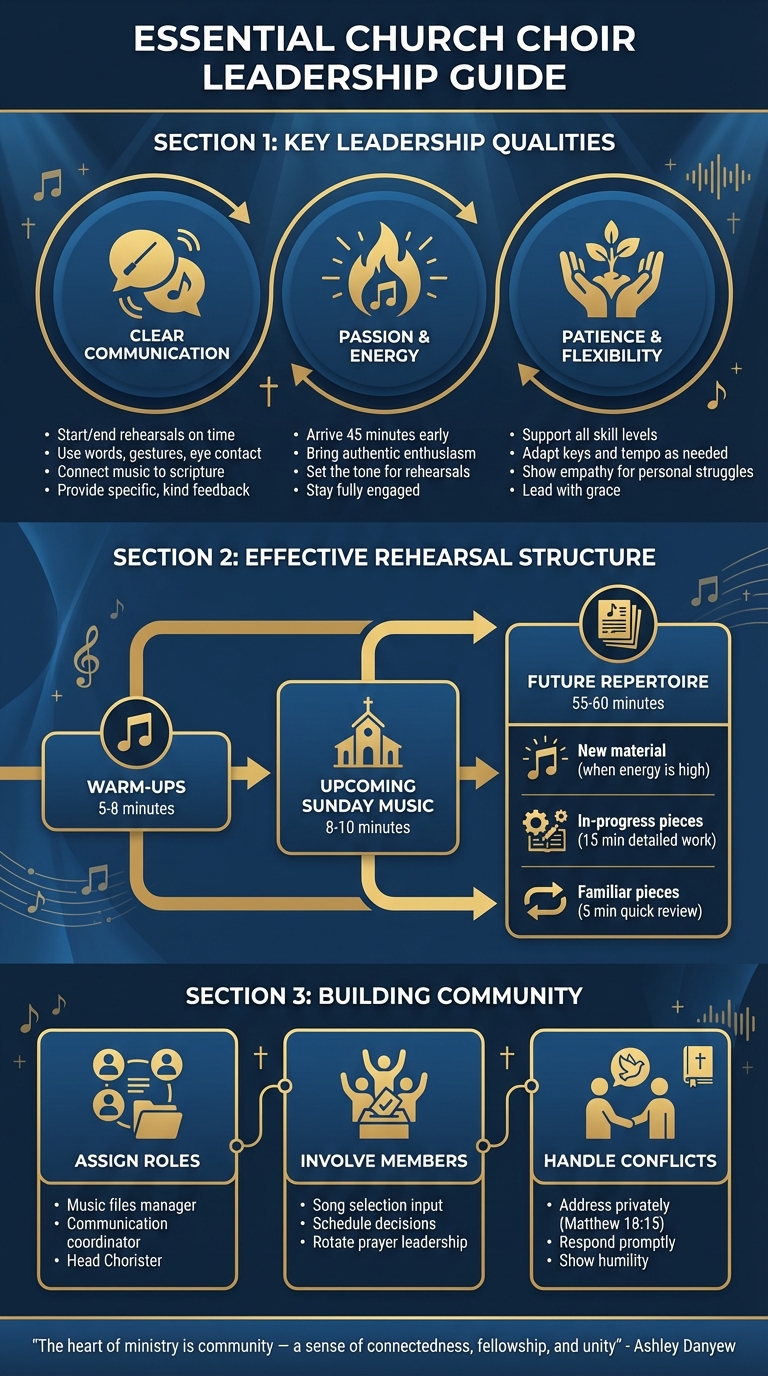
Essential Qualities and Practices for Effective Church Choir Leadership
Webinar: Techniques for Conducting a Church Choir with Angela Westhoff-Johnson
sbb-itb-5a6b344
Key Qualities of an Effective Choir Leader
Leading a church choir takes more than knowing music. As Ashley Danyew, a church music director, explains:
"Leadership has been defined as ‘the art of motivating a group of people to act towards achieving a common goal.’"
Clear Communication
Clear communication is the backbone of strong choir leadership. Whether through words, gestures, eye contact, or facial expressions, your ability to convey musical ideas clearly is key. Connecting each piece to its scriptural and service context helps give the music deeper meaning. Consistency is equally important – stick to clear expectations, maintain steady teaching methods, and offer specific, kind feedback. Respecting your choir members’ time by starting and ending rehearsals on schedule shows your leadership and consideration.
T. Kareem Powell, a minister of music, captures this well:
"Musical direction is about leading your team and making sure everyone is going in the same direction. Musical directors make sure the people in their care have everything they need to do their best work."
Ultimately, your demeanor and energy set the tone for rehearsals. Clear communication is only part of the equation – your passion and enthusiasm are just as essential.
Passion and Energy
Your energy fuels the choir’s performance. When you bring authentic passion to rehearsals, it lifts the spirits of your members, even when they come in feeling drained or discouraged. Your dedication to serving the community through music transforms rehearsals into more than just practice – it becomes worship preparation.
The Berklee College of Music emphasizes this point:
"Excellent interpersonal skills are a must, as are the patience, clarity, and ease of communication necessary to teach well."
Preparation plays a big role here. Arriving at least 45 minutes early to address technical issues shows your commitment and encourages others to follow your example. If you’re not fully engaged, your choir will likely reflect that same attitude. While passion ignites enthusiasm, patience and adaptability ensure lasting progress.
Patience and Flexibility
Patience and flexibility are essential for supporting every choir member, no matter their musical ability or personal challenges. Some members may not read music, and learning complex arrangements takes time. Additionally, personal struggles like work stress, grief, or depression can impact participation. Flexibility allows you to adjust as needed – whether it’s changing keys to suit the singers’ strengths, modifying tempo during a service, or accommodating last-minute changes from pastoral staff.
Leading with empathy means understanding these realities and creating an environment where grace and musical growth go hand in hand.
Planning and Running Effective Rehearsals
Well-organized rehearsals are the backbone of a successful choir. They’re key to creating a group that not only sings in harmony but also connects deeply with their audience. Katherine Tiefel, a music educator, emphasizes this point:
"Success in the choral rehearsal is a direct result of thorough planning."
The difference between a chaotic practice and a focused, productive session lies in how you structure your time and set clear goals.
Setting a Regular Schedule
Consistency is crucial for building commitment and momentum. Establish a fixed day and time for rehearsals – like Sunday afternoons or Wednesday evenings – and stick to it. A predictable schedule helps choir members plan around their commitments and reinforces the importance of showing up. Beyond weekly rehearsals, plan your repertoire and performance dates months in advance. For instance, creating a schedule from September through Christmas gives members a clear roadmap and helps them balance choir with other responsibilities.
Brent Assink, Minister of Music at Calvary CRC, offers a word of caution:
"If you relax, everyone else will too, and the choir’s sense of accomplishment and contribution will suffer."
For groups with limited availability, a seasonal choir model can work wonders. Offering short-term commitments, like a six-week session for Advent or Easter, can attract participants who can’t commit year-round.
Defining Goals for Each Session
Every rehearsal should have clear, actionable goals. Break your repertoire into three categories: new, in progress, and familiar. This helps you allocate time wisely – spend about 15 minutes on detailed work for "in progress" pieces and just 5 minutes for a quick run-through of familiar ones. A typical rehearsal might include 5–8 minutes for warm-ups, 8–10 minutes on the upcoming Sunday’s music, and 55–60 minutes on future pieces.
Start with the most challenging or newest material while energy levels are high, and wrap up with a familiar favorite to end on a positive note. Pinpoint tricky sections – often called "practice spots" – ahead of time so you can dive straight into problem-solving instead of singing through entire pieces unnecessarily. Clear objectives make every minute count.
Using Visual and Musical Cues
Smart warm-ups can set the tone for a productive rehearsal. Design vocal exercises that introduce challenging phrases or musical concepts from the pieces you’ll be working on later in the session. This approach makes warm-ups more than just a routine – it’s practical preparation. When working with a band, rehearse singers separately first to lock in harmonies and find keys that highlight their strengths before adding instruments.
Avoid over-rehearsing a song, as this can sap its energy and freshness. Instead, provide members with quality rehearsal tracks through shared digital folders so they can practice notes at home. This allows group time to focus on refining the ensemble’s sound. Conductor Matt Hill summarizes it well:
"Efficiency breeds productivity. Training creates effectiveness. Community and a shared desire for excellence make the educational process enjoyable."
Choosing and Managing Music Repertoire
Building on an organized rehearsal routine, selecting the right music repertoire plays a key role in enriching the worship experience. The repertoire you choose not only shapes your choir’s growth but also creates moments of spiritual connection that elevate the entire service.
Balancing Difficulty and Accessibility
It’s important to assess your choir’s current abilities realistically. Overestimating their skill level can lead to overly ambitious programming, which can overwhelm and discourage your group. As Matt, founder of The Choir Director Corner, wisely states:
"Remember that under programming is fine, but over programming is DEATH."
Selecting music slightly below your choir’s maximum ability allows them to focus on expression, phrasing, and the emotional depth that transforms a technically correct performance into a truly moving worship experience. Brent Assink, Minister of Music, emphasizes this balance:
"Overloading your choir with too much difficult music can be just as demoralizing as singing the simplest hymn arrangements week after week."
Additionally, consider the vocal makeup of your choir. For example, if male singers are limited, opt for S-A-B (Soprano-Alto-Baritone) or two-part arrangements instead of the traditional SATB format. Keeping a few simpler anthems on hand can also be a lifesaver when illness or fatigue affects your group. Introducing variety – whether in styles, time periods, or composers – keeps both the choir and the congregation engaged.
This thoughtful approach to repertoire selection aligns with your role as a leader: to inspire worshipful engagement and create a meaningful experience for everyone involved.
Using Christian Accompaniment Tracks
To complement your carefully chosen repertoire, church accompaniment music can elevate your choir’s performance, especially when live musicians aren’t available. These tracks, priced at just $5.00 each, are designed to mirror original performances and provide a polished, reliable backing. They help maintain consistent tempo, allowing singers to focus on harmonies and vocal delivery.
The stability these tracks offer can be a game-changer during rehearsals, building your choir’s confidence. As T. Kareem Powell, Musical Director, explains:
"Your main goal is to build confidence in the music. If your singers feel confident in their ability to sing it and know what to expect, then they will deliver."
Using accompaniment tracks during mid-week rehearsals can help your choir get familiar with specific arrangements and cues before Sunday services. These tracks are particularly helpful for smaller choirs or groups still developing their skills, as they provide a full, supportive sound that highlights how each part contributes to the overall performance.
When selecting tracks, ensure they match your choir’s vocal range and align with the worship theme, creating a seamless and cohesive flow throughout the service.
Building Relationships Within the Choir
Strong relationships are just as important to choir leadership as achieving musical excellence. A connected and supportive community not only enhances worship but also elevates performance. When a choir feels like a true community, it becomes more than just a group of singers. As Ashley Danyew, Church Musician and Author, explains:
"The heart of ministry is community – a sense of connectedness, fellowship, and unity; shared responsibility and ownership."
Building trust begins with small but meaningful actions. Arriving 10–15 minutes early to chat with members or checking in when someone misses a session shows genuine care and reinforces their value. These simple gestures create the foundation for a choir that feels united in purpose. Additionally, fostering connections during rehearsals is essential. Consider setting aside 5–10 minutes for a social break, giving members time to bond without interrupting the flow of practice. Starting or ending rehearsals with a time to share joys, concerns, or prayer can also strengthen relationships. Beyond rehearsals, hosting annual social events, like a Christmas party or summer picnic, can deepen these bonds even further.
Next, let’s explore actionable ways to create a collaborative and harmonious choir environment: assigning roles, involving members in decisions, and addressing conflicts effectively.
Assigning Roles and Responsibilities
Empowering choir members with specific roles builds trust and a sense of ownership. Delegating tasks not only lightens the load for leaders but also fosters a stronger, more self-sufficient group. For instance, you could assign responsibilities like managing music files, coordinating communication, or organizing meals for members in need. Appointing a "Head Chorister" or "Choir Captain" to serve as a role model for dedication and teamwork can also be highly effective. Make expectations clear to encourage cooperation, and publicly acknowledge these contributions during services to highlight their importance.
Involving Members in Decisions
When choir members have a say in decisions, they feel more connected to the group’s mission. Engage your singers by involving them in choices about song selections, rehearsal schedules, and special events. Transparency is key – sharing meeting notes, financial updates, and strategic plans helps build trust. As Tom Metzger of Choir Genius points out:
"Trust is earned through transparency. Make information such as meeting notes, financial reports, and strategic plans available to members."
You can also rotate responsibilities, such as leading prayer, to encourage collaboration and give everyone a chance to contribute.
Handling Conflicts
Conflict is inevitable in any group, but addressing it effectively can strengthen your choir. Ignoring issues only allows them to grow. As ChurchLeaders Staff advises:
"Avoidance is not biblical peacemaking. It is deferred leadership."
Handle conflicts promptly and privately, following the guidance of Matthew 18:15, which encourages addressing concerns one-on-one. Approach disagreements with humility, patience, and an understanding of the challenges members may face outside of choir, such as work stress or personal struggles. Sometimes, stepping away from the music to offer support can make all the difference. T. Kareem Powell, Musical Director, puts it well:
"Musical directors make sure the people in their care have everything they need to do their best work."
Consistency in rehearsals is another key to avoiding frustration. Clear expectations and reliable structures help volunteers feel secure and valued, reducing the risk of losing members due to confusion or disorganization. By addressing conflicts with fairness and compassion, you not only protect relationships but also reflect the love and care that should be at the heart of ministry.
Conclusion
Leading a church choir goes beyond music – it’s about nurturing your team, fostering connections, and building a ministry grounded in faith. As T. Kareem Powell puts it, "Musical directors make sure the people in their care have everything they need to do their best work". This involves being prepared, mastering the music, and setting a strong example through dedication and spiritual commitment.
The key practices outlined here – like clear communication, well-planned rehearsals, selecting accessible repertoire and planning setlists, and cultivating a sense of community – are essential for a flourishing choir. Planning rehearsals 8–12 weeks ahead instead of scrambling last-minute not only boosts your singers’ confidence but also respects their time as volunteers. Starting rehearsals with prayer and reflection strengthens the spiritual connection between your music and worship. And as Brent Assink wisely notes, "If you demand much of your members, demand more of yourself".
Your choir’s role is twofold: leading the congregation in worshipful singing and serving as a small group where members grow in faith and care for one another. By investing in relationships – whether it’s arriving early to connect with members, checking in on those who miss rehearsals, or resolving conflicts with humility – you create a community that mirrors the love central to ministry.
Start implementing these ideas today. Whether it’s creating practice resources, setting a consistent rehearsal schedule, or celebrating milestones like birthdays, every small action strengthens your leadership and enriches your choir’s ministry. Effective leadership is built on a solid foundation, deeply connected to the community and centered in Christ – and that’s where meaningful change begins.
FAQs
How can I keep volunteers committed long-term?
To keep volunteers engaged and dedicated, it’s important to build strong connections and create an atmosphere that feels welcoming and meaningful. Make sure they feel valued by expressing gratitude regularly, staying in touch, and acknowledging their contributions in heartfelt ways.
Be clear about expectations, offer continuous training, and invite them to participate in decision-making processes. When you cultivate an environment of appreciation, open dialogue, and consistent support, you help prevent burnout, lift their spirits, and inspire a lasting commitment to the church’s mission.
What should I do when my choir can’t handle the music?
If your choir is having a tough time with the music, try making practice tracks to boost their confidence and give them a way to prepare outside of rehearsals. During practice, zero in on the tricky spots, offer clear and constructive feedback, and provide opportunities for additional training or support. These steps can help your choir grow stronger and perform with greater confidence.
How can I lead rehearsals that feel spiritual, not stressful?
To help rehearsals feel more like a spiritual experience rather than a source of stress, try weaving in practices that connect the music to its deeper meaning. For example, link lyrics to Scripture, encourage moments of reflection, and emphasize the biblical truths behind the songs. You can also nurture a sense of fellowship by starting or ending with prayer, sharing a short devotion, or reading Scripture to set a reverent atmosphere. By balancing spiritual growth with musical preparation, choir members can see their singing as an act of worship, making the experience more meaningful and uplifting for everyone involved.