
How To Organize Worship Team Rotations
Organizing worship team rotations is all about creating a system that prevents burnout, builds team chemistry, and respects volunteers’ time. Here’s the key takeaway: structured rotations help your worship team thrive while maintaining balance and consistency.
Quick Steps to Get Started:
- Understand Your Team’s Needs: Evaluate team size, roles, and availability.
- Create Balanced Teams: Group experienced and newer members together for mentorship and consistency.
- Set Clear Schedules: Volunteers should serve no more than twice a month, with schedules posted at least a month in advance.
- Use Scheduling Tools: Platforms like Planning Center simplify scheduling, communication, and tracking availability.
- Encourage Flexibility: Allow volunteers to manage conflicts by finding their own replacements.
- Plan Ahead: Batch-plan song sets using a worship setlist planner and rehearsals for smoother preparation.
- Prevent Burnout: Rotate team members regularly and ensure everyone gets breaks.
The result? A well-organized team that leads worship effectively and stays energized over time.
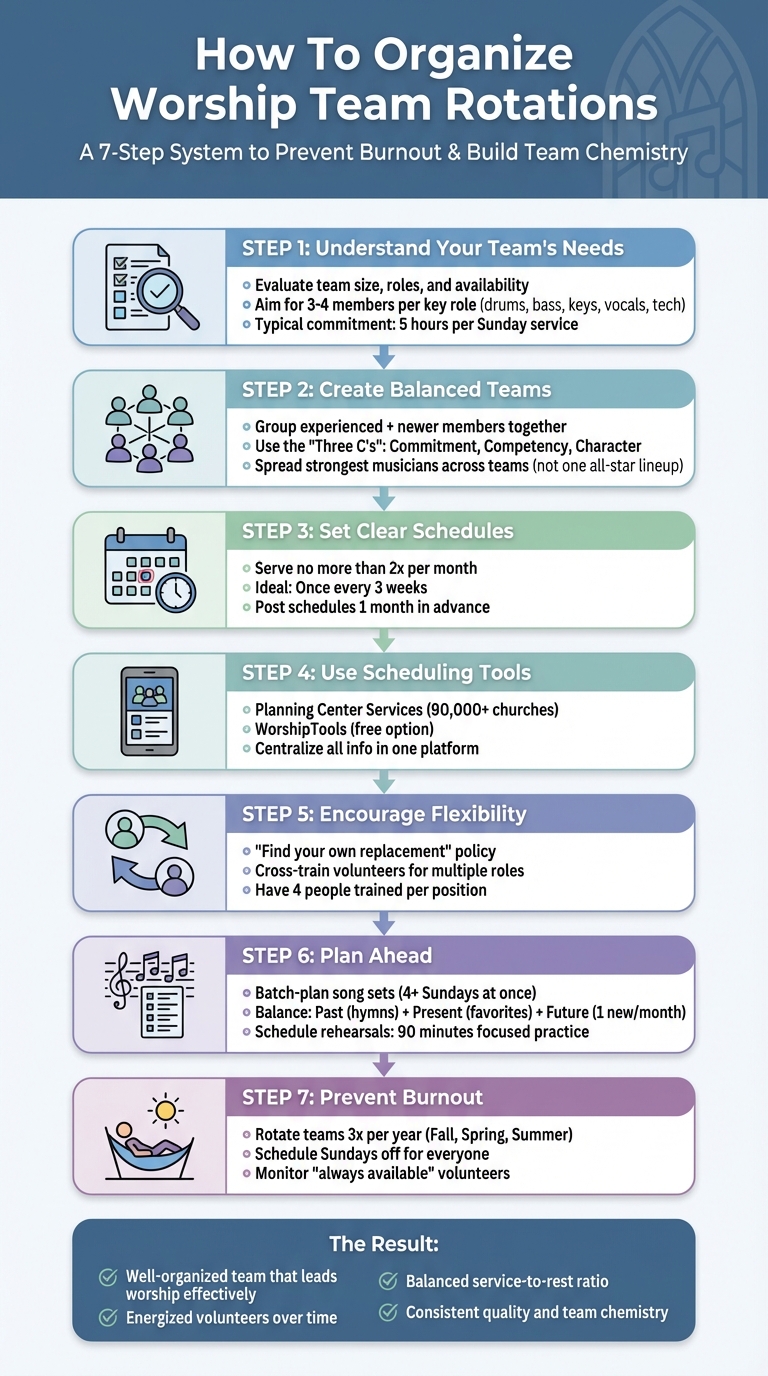
7-Step Process for Organizing Worship Team Rotations
6 TIPS FOR SCHEDULING WORSHIP TEAM MEMBERS
sbb-itb-5a6b344
Assess Your Worship Team Needs
Now that you’ve grasped the value of structured rotations, it’s time to take a closer look at your team’s capabilities. Before diving into rotations, evaluate where your team stands. Start by reviewing your team’s size, the roles that need to be filled, and how often your volunteers are available to serve.
Identify Team Roles and Responsibilities
A worship team is much more than just the musicians on stage. It’s a mix of front-line and behind-the-scenes roles, all working together to create a meaningful worship experience.
Of course, vocalists and instrumentalists lead the congregation. But as Joshua Gordon, Senior Editor at TheLeadPastor.com, wisely points out:
"The worship team’s role is to lead the congregation into worship, not to perform."
Beyond the stage, you’ll need a Worship Administrator to handle scheduling, update planning software, and organize chord charts. A Musical Director acts as the band leader during rehearsals and services, ensuring smooth transitions and providing real-time cues. On the tech side, an Audio Technician manages sound mixing and monitors, ensuring proper microphone use in worship, while a Video/Lighting Operator handles visuals like lyrics projection and lighting cues. In larger churches, a Producer might oversee all production elements to ensure everything runs smoothly.
For a well-rounded team, aim to have 3–4 members ready to cover key roles like drums, bass, keys, vocals, and tech positions.
Determine Service Schedules and Frequency
Once roles are clear, figure out how much time your volunteers need to commit. For a typical Sunday service, volunteers often dedicate about 5 hours, not including midweek rehearsals.
A practical example comes from a church that uses a pool of 30–32 regular team members. This allows them to staff a weekly band of 5–7 people and a tech team of 4–6, striking a balance between consistency and avoiding burnout. The ideal schedule for most churches is having volunteers serve once every three weeks, though many stick to a policy of no more than twice a month.
Be mindful of the "service to rest" ratio. Over-scheduling can lead to what Zach Boyd describes as a "burn-out factory". Also, plan for special events like Easter or Christmas, which may require larger teams or your most experienced members.
Evaluate Member Availability
Using a church service planner can simplify tracking availability. Shift the responsibility to your volunteers by having them mark the dates they’re unavailable.
Set a clear deadline – many churches remind team members around the 15th of each month to block out their unavailable dates for the upcoming month. Then, establish a policy: if someone doesn’t mark their dates and gets scheduled, they’re responsible for finding a replacement.
"Your systems create behavior. Good systems produce good behavior, and bad systems produce, well, ulcers."
Consider seasonal rotations by reorganizing teams three times a year – Fall, Spring, and Summer. This approach matches natural life rhythms, offering "on-ramps" for new members and "off-ramps" for those needing a break. When scheduling, plan at least a month in advance to give volunteers enough notice, but avoid scheduling more than three months ahead to allow flexibility for bringing in new team members.
With a clear plan for roles, schedules, and availability, you’re ready to build balanced and effective worship teams.
Build and Structure Worship Teams
Once you’ve assessed your team’s needs and availability, it’s time to organize volunteers into well-structured groups. The aim is to establish fixed rotating teams that serve together regularly, rather than shuffling musicians every week. Consistency helps musicians develop a natural rhythm together – drummers and bass players sync up, guitarists complement each other, and vocalists harmonize more fluidly. This foundation leads to balanced teams, which is the next step.
Form Balanced Teams
Start by evaluating team members using the Three C’s: Commitment (their involvement in church life), Competency (their level of musical skill), and Character (humility and a servant’s heart). As Joshua Gordon from TheLeadPastor.com wisely says:
"Faithfulness over flashiness – every time".
Next, identify your "glue" musicians – those reliable players (often drummers) who anchor the team with solid timing. Their dependability allows you to rotate less experienced musicians without disrupting the group’s cohesion. As Worthily Magnify highlights:
"If [the drummer] is weak, the whole sound is weak. The importance of a good, solid, in-time, dependable, and sensitive drummer cannot be overemphasized".
Spread your strongest musicians across teams rather than creating one "all-star" lineup. Pair newer musicians with seasoned players to foster mentorship during rehearsals and services. If a team lacks a key instrument, such as a drummer, consider alternative arrangements. For example, you could opt for stripped-back sets with piano and strings or acoustic guitars instead of overburdening one volunteer.
To build team identity, consider naming teams after members (like "Team Omar") instead of assigning numbers. This personal touch can help quieter members feel more appreciated. Reorganize teams three times a year – fall, spring, and summer – to allow for smooth transitions as new volunteers join or others take breaks.
Assign Fixed Team Roles
Clearly define core positions for each team, such as Worship Administrator (handles logistics and scheduling), Musical Director (leads the band and cues transitions), Vocalists/Musicians, Audio Technician, and Video/Lighting Operator. These fixed roles establish accountability and ensure everyone knows their responsibilities.
Maintain a backup pool of 3–4 people per position – drums, bass, keys, vocals, and tech roles. This reduces burnout and guarantees you have qualified individuals ready to step in when needed. Some larger churches even limit volunteers to serving no more than twice a month to prevent exhaustion.
Use "on-ramping" strategies to train newer members. For example, let them lead a single song during a set or serve in smaller settings like youth groups or midweek services before they take on regular Sunday roles. As Zach Boyd from Pushpay explains:
"Cultivating more leaders is also a way of recognizing that you are not the end-all-be-all of your church; plus, cultivating leaders is one of the central elements of making disciples".
Enable Internal Flexibility
Even with fixed roles, life can be unpredictable. Encourage internal flexibility by implementing a "find your own replacement" policy. If someone can’t serve on a scheduled date they didn’t block out in advance, they must arrange for a substitute from the approved volunteer pool.
Cross-train volunteers to handle multiple roles whenever possible. For instance, a camera operator who can also run lyrics or a guitarist who can play keys provides crucial backup during unexpected absences. Having four people trained for each position ensures smoother scheduling and makes the team adaptable to last-minute changes.
Create and Manage Rotation Schedules
A well-organized scheduling system can save everyone a lot of headaches and avoid those last-minute scrambles. By establishing a predictable rhythm, you can ensure smooth rotations and keep things running seamlessly. As Matt, a Worship Team Coach, puts it:
"Your systems create behavior. Good systems produce good behavior, and bad systems produce, well, ulcers."
Once roles are defined and availability is confirmed, the next step is to streamline your rotation schedule.
Choose a Scheduling Tool
Finding the right tool is key to managing schedules effectively. Planning Center Services is a popular choice, trusted by over 90,000 churches for service planning and volunteer scheduling. It offers features like automated reminders, a mobile app, and centralized storage for setlists and church accompaniment music files. Pricing starts free for up to 5 team members and scales to $15/month for 20 members, $32/month for 50 members, and up to $239/month for unlimited team members.
For those looking for a free option, WorshipTools provides similar features, including service planning, volunteer scheduling, and mobile access.
If you’re working with a tight budget, Google Sheets can handle basic rotation schedules. However, the key is to stick to one centralized tool. Avoid scattering information across platforms like Dropbox, Facebook messages, and email, as this can lead to confusion and force team members to dig around for details. Dedicated apps simplify the process with automatic notifications and allow volunteers to accept or decline assignments instantly, cutting out the back-and-forth.
Develop Rotation Plans
Aim to schedule rotations at least one month in advance, but no more than three months ahead, to maintain flexibility. Batch processing can save time – schedule four or more Sundays in one sitting instead of tackling them week by week. As Matt explains:
"It takes less time to schedule four Sundays at one time than it does to schedule four Sundays at four different times."
This approach also clarifies responsibilities. If a team member is scheduled on a date they blocked, it’s your job to find a replacement. But if they fail to block a date, they’re responsible for securing their own substitute. Use the matrix or grid view in your scheduling software to review multiple weeks at once, ensuring balanced assignments across teams. Many apps also include a "clone" feature – use it to replicate schedules quickly, then make adjustments as needed.
Be sure to schedule Sundays off for every team member to prevent burnout. If skipping an instrument for a week is necessary to give someone a break, it’s often the better choice. One worship coach emphasizes:
"The health of you and your team is more important than maintaining the façade of a full band."
Once your schedules are finalized, share them with your team promptly.
Communicate the Schedule
Post the schedule by the 15th of the month for the following month. This two-month lead time gives team members enough notice to prepare or request changes before commitments are set in stone.
Use different communication channels based on urgency:
- Routine updates like schedules, setlists, and reminders can go out via email or app notifications.
- Urgent matters like last-minute cancellations should be handled through texts or phone calls.
- Important announcements like policy updates or training events might even warrant a mailed notice.
Before posting the schedule, send a reminder asking team members to block out any unavailable dates. Once the schedule is live, follow up with a confirmation and send reminders ahead of each rehearsal.
To ensure accountability, require team members to use the "Accept" or "Decline" features in your scheduling tool. This way, you’ll know exactly who’s committed well before the service day arrives, eliminating any uncertainty.
Plan Song Sets and Rehearsals
With rotation schedules in place, it’s time to focus on crafting engaging song sets and organizing efficient rehearsals. Proper planning here can save you from last-minute stress and ensure everything runs smoothly.
Batch-Plan Song Sets
Instead of creating a new setlist every week, consider planning several weeks of services in one session. This approach not only saves time but also helps you spot patterns and maintain a good balance in your song selection.
To keep things fresh and engaging, organize your song sets into three categories: Past (familiar hymns), Present (current favorites), and Future (new additions). Aim to include one or two familiar songs each week, let current favorites dominate the set, and introduce only one new song per month. This balance keeps the congregation comfortable while gradually introducing fresh material.
Using a planning tool can help track how often each song is played, preventing overuse while ensuring cherished songs remain part of the rotation. If your pastor provides sermon themes or scripture readings in advance via a cloud-based tool, align your song choices to complement the message rather than compete with it.
Once your song sets are finalized, sync them with your rehearsal schedule to ensure everyone is on the same page.
Schedule Team Rehearsals
Rehearsals and individual practice serve different purposes. Practice is when each team member learns their parts on their own, while rehearsals focus on bringing the group together to refine transitions, dynamics, and the overall sound. Make sure everyone comes prepared to rehearsal.
A well-structured 90-minute rehearsal might include a short devotional, a focused run-through of the setlist, and a closing prayer. Pay close attention to transitions – how songs begin and end, as well as any spoken moments in between – to avoid awkward pauses during the service.
Use Christian Accompaniment Tracks
Accompaniment tracks can be a game-changer, especially if you’re missing certain instruments or working with less experienced musicians. Websites like Christian Accompaniment Tracks offer affordable, high-quality tracks that mimic original performances for just $5.00 each.
Share these tracks through your scheduling tool so team members can practice on their own. You can adjust the tracks to match your desired key or slow them down to help musicians master tricky parts. Worship Ministries Strategist Kenny Lamm highlights their value:
"I have found choirs will attain a higher level of excellence and be able to memorize music much quicker when they have listening aids to go with them throughout the week."
During rehearsals and services, these tracks provide a steady rhythm and help maintain cohesion when full instrumentation isn’t available. Uploading them to your centralized planning platform ensures everyone has 24/7 access, promoting consistent preparation and confidence.
Maintain Flexibility and Make Adjustments
Even with structured rotations and clear schedules, maintaining flexibility is key to keeping your worship team running smoothly. Life happens – illnesses, last-minute work changes, or unexpected conflicts can disrupt even the most well-planned schedules. By designing a system that allows for adjustments from the start, you can avoid unnecessary stress later on.
Encourage Self-Managed Replacements
Empower your team members to take charge of their own scheduling conflicts. Tools like Planning Center make this process simple – volunteers can request substitutes with just one click, automatically notifying other qualified team members to step in.
This approach shifts responsibility to team members for finding their replacements when they can’t make it. Scheduling software also provides visual cues – like yellow squares for conflicts, red squares for blocked dates, and green circles for preferred times – so you can catch potential issues before finalizing the schedule.
Monitor and Adjust Rotations
Your rotation system shouldn’t be set in stone. Regularly reviewing schedules helps you catch imbalances before they become bigger issues. Use features like the "Matrix" or "Grid" view in your scheduling software to see multiple weeks at a glance, making it easier to spot gaps or uneven workloads.
Pay attention to team members who are "always available" but rarely take breaks. Worship Team Coach advises, "It’s not as fun, but you and your team’s health is more important than maintaining the façade of a full band". Encourage these dedicated volunteers to set boundaries and take regular time off to avoid burnout.
When adjustments are needed, consider pairing experienced musicians with those who are still learning. This not only helps maintain the quality of your team but also creates mentoring opportunities. Regularly tweaking lineups ensures balance and keeps the team dynamic fresh.
Use Clear Communication Strategies
Streamline your communication to avoid overwhelming team members. Assign specific roles to each communication channel – for example, use texts for urgent updates and email or app notifications for routine information.
Your scheduling platform should act as the go-to resource for everything – schedules, setlists, and quality accompaniment tracks – all accessible 24/7. On the 15th of each month, remind team members to update their blockout dates for the next two months to stay ahead of conflicts.
Finally, before finalizing any schedule, have a second person review it. A fresh set of eyes can catch mistakes or imbalances that you might have missed. This extra step ensures a smoother experience for everyone involved.
Conclusion
Creating an effective worship team rotation doesn’t have to feel overwhelming. By evaluating your team’s needs, forming balanced groups, and using reliable scheduling tools, you can build a system that works smoothly. Balanced rotations not only help avoid volunteer burnout but also strengthen relationships as team members rehearse consistently together. Plus, they open doors for developing new leaders by reducing reliance on just one person. As Zach Boyd from Pushpay explains:
"The health of a worship team usually comes down to leadership. It can be the difference between operating a burn-out factory or managing a thriving, self-sustaining stream of new and experienced volunteers".
The way you schedule can have a big impact – organized systems encourage volunteers to take ownership of their roles, while disorganization often leads to stress. A practical example is scheduling volunteers to serve about once every three weeks, which many find to be a manageable rhythm. Planning ahead with song sets and using resources like Christian Accompaniment Tracks (available for $5.00 each at https://christianaccompanimenttracks.net) can help your team stay prepared, even when someone is unavailable .
While structure is important, flexibility is equally key. Life happens, and your system should be ready to adapt. By empowering team members to handle scheduling conflicts and regularly checking for balance in rotations, you can maintain a system that supports both the team and the ministry. When volunteers feel appreciated, equipped, and part of a genuine community – not just filling a spot – they’re more likely to stay committed. A rested, well-supported team creates a worship experience that engages and uplifts every time.
FAQs
How big does my worship team need to be for rotations?
When it comes to worship team rotations, there’s no one-size-fits-all approach. A common arrangement might involve 5-7 band members and 4-6 tech volunteers, drawn from a pool of about 30-32 people. For smaller churches, teams can often function effectively with just 3-4 members. The goal is to have enough people to allow for regular rotations, avoiding burnout while meeting the unique needs of your church’s size, volunteer availability, and worship ministry.
How do I handle last-minute call-outs?
To handle those last-minute call-outs on your worship team, it helps to have a backup plan in place. Start by building a pool of team members who are comfortable covering multiple roles. This way, you’ve got some flexibility when things don’t go as planned. Pair that with a structured scheduling system that makes it easy to shuffle things around quickly. It’s also smart to keep a list of standby volunteers who are ready to step in during emergencies. And don’t underestimate the power of clear, prompt communication – it’s essential for keeping transitions smooth and ensuring the quality of your service stays consistent, even when the unexpected happens.
How can I train new volunteers without hurting quality?
To prepare new volunteers effectively, it’s important to establish clear expectations upfront. Outline practice schedules, the level of commitment required, and the expected conduct. A structured onboarding process can make all the difference – this might include assessments for both spiritual alignment and musical skills, pairing new members with mentors, and providing consistent feedback.
Lead by example to inspire dedication and offer ongoing training opportunities to help volunteers refine their skills. Additionally, thoughtful team rotations can balance quality with individual availability, ensuring that every volunteer has the chance to grow while contributing meaningfully to the team.