
Backing Tracks vs. Live Accompaniment for Rehearsals
When preparing for a solo worship performance, you’ll need to decide between choosing quality backing tracks or live accompaniment. Backing tracks are pre-recorded instrumental files, while live accompaniment involves working with musicians in real-time. Each option offers distinct advantages and challenges, impacting your practice, performance, and budget. Here’s a quick breakdown:
- Backing Tracks: Affordable, consistent, and convenient for solo practice. Ideal for rehearsing anytime without scheduling conflicts. Downsides include limited flexibility and less energy compared to live musicians.
- Live Accompaniment: Offers real-time adjustments, teamwork, and a stronger emotional connection. However, it’s more expensive, requires coordination, and can lead to inconsistent rehearsals.
Quick Comparison
| Criteria | Backing Tracks | Live Accompaniment |
|---|---|---|
| Cost | $5–$6 per track, one-time purchase | Recurring costs (musicians, equipment) |
| Flexibility | Fixed tempo, no on-the-fly adjustments | Adapts to tempo and dynamics changes |
| Convenience | Practice anytime, anywhere | Scheduling and rehearsal logistics |
| Energy | Polished but less engaging | Dynamic and interactive |
| Consistency | Same performance every time | Varies based on preparation and mood |
Both approaches can work depending on your needs. Backing tracks are perfect for budget-conscious soloists who value convenience, while live musicians add depth and spontaneity for larger, more interactive performances. Some performers even combine both for the best of both worlds.
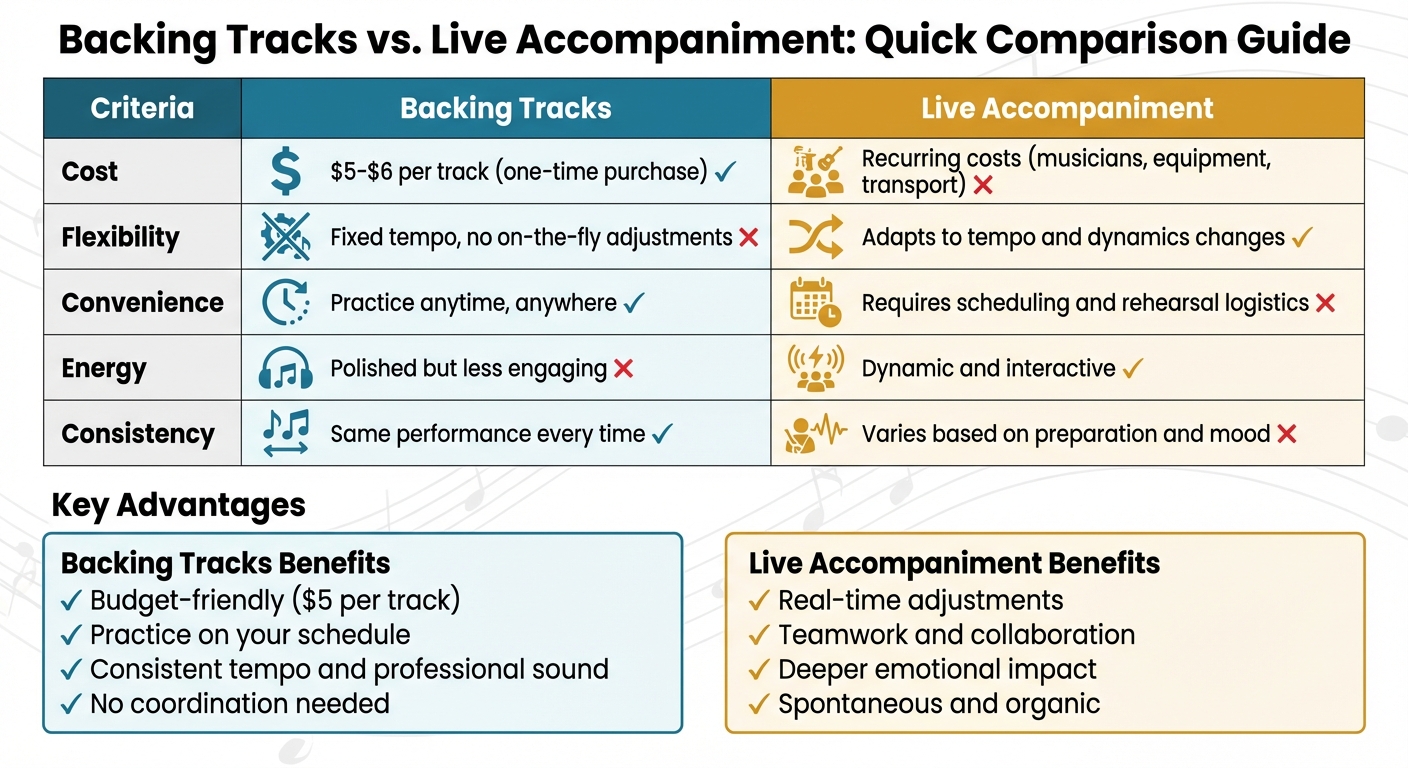
Backing Tracks vs Live Accompaniment Comparison Chart
💻 Backing Tracks in Your Live Shows: Essential or Overrated?
sbb-itb-5a6b344
Benefits of Backing Tracks
Backing tracks provide a dependable and budget-friendly solution for focused solo practice.
Steady Tempo and Professional Sound
With backing tracks, you get a consistent tempo, thanks to their built-in metronome, ensuring your timing stays on point. These tracks also offer professional-grade audio, featuring layers like keyboard pads, ambient tones, strings, percussion, and background vocals. This creates a full, rich sound that would typically require a team of musicians to achieve.
"Adding a track not only helps everyone play more ‘in the pocket,’ but the extra parts create a fuller sound" – Kent Wade, Pastor of Worship at The Chapel EFC
This combination of precision and quality makes backing tracks an efficient choice for rehearsals.
Budget-Friendly Solution
Compared to hiring and coordinating a group of musicians for every practice session, backing tracks are a much more affordable option. You pay for a track once and can use it as many times as needed. For example, Christian Accompaniment Tracks offers high-quality recordings for just $5.00 each, a fraction of the cost of live accompaniment. This affordability allows you to expand your repertoire without breaking the bank.
But the benefits don’t stop at cost savings – backing tracks also offer unmatched flexibility.
Practice on Your Schedule
One of the greatest perks of backing tracks is the freedom to practice whenever and wherever you want. Whether you’re at home, in your car, or on the go, you can load these tracks onto your iPhone, iPad, or laptop and rehearse without worrying about coordinating with other musicians or booking rehearsal spaces.
Modern stem-based tracks take this flexibility even further. They let you isolate specific instruments to hear how professionals play a section, then mute those parts to focus on your vocal line. Tools like MultiTracks allow you to zero in on tricky passages, giving you the chance to perfect them before a live performance. This adaptability helps build confidence and polish your skills at your own pace.
Drawbacks of Backing Tracks
While backing tracks offer consistency, they come with challenges that can limit flexibility during rehearsals.
No Room for Adjustments
One major downside of backing tracks is their inflexibility. They stick to a pre-determined timeline, so if you speed up, slow down, or miss a cue, the track won’t adapt. Unlike live musicians who can adjust to your tempo or dynamics, a backing track simply plays on as recorded. Kerry Hishon, a Theatre Educator at Theatrefolk, sums it up perfectly:
"Since tracks are pre-recorded, they do not allow for adjustments on the fly. If your students speed up, slow down, or miss a cue, the music will just keep on going without them, and it can be challenging to get things back on track."
This lack of flexibility can make rehearsals more rigid and less forgiving.
Less Energy and Movement
Backing tracks can also feel less engaging compared to live music. Without the real-time interaction that comes from live musicians, tracks may lack the energy and fluidity that inspire performers. The natural groove and dynamic shifts of a live band often push performers to excel, creating a sense of connection and momentum that pre-recorded tracks just can’t replicate . This absence of human interaction can make rehearsals feel less motivating and vibrant.
Timing Difficulties
Staying in sync with a fixed-tempo track can be tricky. If you miss an entrance or lose your place, the track moves forward regardless, making it hard to catch up. Many performers use a click track in their monitors to stay on tempo, but this can feel restrictive compared to following live cues . Additionally, technical issues and the rigid nature of backing tracks make it harder to recover from mistakes . These challenges can add pressure, especially during high-stakes performances.
Benefits of Live Accompaniment
Having live musicians by your side brings a level of interaction and flexibility that pre-recorded tracks just can’t match. The ability to adapt in real time creates a dynamic and engaging experience that enhances both rehearsals and performances.
Real-Time Adjustments
Unlike rigid backing tracks, live musicians can respond instantly to changes. Whether you slow down for dramatic effect, speed up during an emotional high point, or need to recover from a missed entrance, live accompanists adjust seamlessly. This kind of flexibility allows you to focus on expression rather than worrying about sticking to a fixed timeline. Theatre Educator Kerry Hishon explains it well:
"With live bands, the conductor can make adjustments on the fly if something goes wrong, such as tempo changes or adding additional repeats to cover a mistake."
Similarly, Pastor of Worship Kent Wade highlights the challenges of using tracks when spontaneity is required:
"If the worship leader misses an entrance or changes the structure, we might need to cut the track and rely on our listening skills to stay in sync."
This adaptability ensures a smoother rehearsal process and a more organic performance.
Teamwork and Real Performance Feel
Rehearsing with live musicians builds essential communication skills for live performances. You learn to pick up on cues, listen to the group as a whole, and react to the energy of the moment. Director of Worship Leah Kurtz emphasizes how team rehearsals strengthen communication and create a vibrant performance energy.
Beyond the technical aspects, the presence of live musicians adds a visual and emotional depth to your performance. In church worship settings, this shared energy fosters a sense of connection and community that pre-recorded tracks simply can’t replicate. This collaborative process lays the foundation for a more emotionally resonant performance. Understanding how accompaniment tracks improve worship engagement can help leaders balance these live elements with recorded support.
Deeper Emotional Impact
Live music has a unique effect on the brain, engaging it in ways that recorded tracks cannot. Research shows that live music consistently stimulates the brain’s emotional centers more effectively than recorded music. For example, the likelihood of significant activity in the amygdala – the brain’s emotional processing hub – is much higher with live music compared to recorded tracks.
This emotional engagement enhances the rehearsal experience. As Vocalist.org.uk notes:
"The energy provided by a band of musicians also helps to enhance the performance and can motivate the singer to perform at a higher standard."
Live musicians create an energy exchange that inspires and elevates everyone involved, creating a momentum that static tracks simply can’t achieve.
Drawbacks of Live Accompaniment
While live musicians bring energy and spontaneity to a performance, they also present challenges that can slow down rehearsals and increase complexity.
More Expensive
Hiring live musicians isn’t cheap. Each musician requires payment, and there are added costs for equipment rentals, transportation, and extra rehearsal time. Theatre Educator Kerry Hishon explains:
"A live band will also need additional rehearsal time both on their own and with the actors (called a sitzprobe) so that they are not performing the music for the first time at a tech rehearsal or cue-to-cue."
Sheldon Conrich, Founder of Acoustic Backs & Tracks, further highlights the financial burden:
"Hiring a full band or even just a pianist or guitarist will add to your expenses – not just in terms of fees, but also equipment, transport, and potentially rehearsal time."
In contrast, backing tracks for choir and soloists are far more budget-friendly. High-quality tracks typically cost between $5.00 and $6.00 per song, and this one-time expense avoids the recurring costs tied to live musicians. Vocalist.org.uk emphasizes:
"The cost of even a professional bespoke backing track is significantly lower than the cost of hiring a professional live band."
Besides the direct costs, scheduling rehearsals with multiple musicians can be a logistical headache.
Coordination Problems
Managing live musicians often comes with scheduling conflicts. Professional musicians frequently juggle other commitments, making them unavailable for mid-week rehearsals or events planned on short notice. Sheldon Conrich points out:
"Great musicians aren’t always available, especially for short notice gigs or mid-week events."
Additionally, musicians often have less time to learn the material compared to the performers. This makes early sitzprobes essential to iron out technical issues. However, coordinating sound mixing, setting up equipment, and managing onstage logistics takes significantly more effort than simply pressing play on a pre-recorded track. For those in leadership roles, following a track selection guide can help streamline this process.
Inconsistent Results
Human performance, by its nature, can vary from one rehearsal to the next. Timing, tuning, and accuracy may fluctuate, especially if musicians have had limited time to prepare. Kerry Hishon reminds us:
"Musicians are human and will make errors. Musicians have to learn the music just like the student performers and often in a shorter amount of time."
Volume control can also become an issue. Instruments like drums or guitars may overpower vocals, and some musicians might not follow the conductor’s cues closely, making it harder for singers to hear themselves. Vocalist.org.uk warns:
"an inexperienced and un-rehearsed band can destroy the singers performance and confidence by playing out of time, tune and not communicating with each other on stage."
Another potential disruption is "noodling", where musicians play unrelated riffs during pauses, which can derail focus during rehearsals. These inconsistencies contrast sharply with the predictability of backing tracks, which deliver the same performance every time you hit play.
Side-by-Side Comparison
Let’s break down the key differences between backing tracks and live musicians. By focusing on cost, consistency, and flexibility, you can make an informed choice that aligns with your needs as a performer.
Cost
Backing tracks are by far the more affordable option. For as little as $5.00 to $6.00 per song – or around $49.00 for custom arrangements – you can access professional-quality music. In contrast, hiring live musicians involves recurring costs, plus extras like transportation and equipment rentals. Vocalist.org.uk captures it perfectly:
"The cost of even a professional bespoke backing track is significantly lower than the cost of hiring a professional live band".
For soloists on a tight budget, this difference can be a game-changer.
Consistency
When it comes to reliability, backing tracks take the lead. They deliver the same tempo, arrangement, and sound quality every single time, making them ideal for soloists who need predictable rehearsal conditions. Live musicians, while full of energy and spontaneity, naturally introduce variation. Their performance can depend on factors like preparation, mood, or even how well they’re syncing with other players. If you’re learning a new song, backing tracks allow you to rehearse the exact version you’ll perform – no surprises, no adjustments.
Flexibility and Accessibility
Backing tracks offer unmatched convenience. You can practice anytime – whether it’s early morning or late at night – without needing to coordinate schedules or find a rehearsal space. All you need is a mobile device and a speaker. On the other hand, live musicians bring real-time adaptability. They can adjust tempo, follow your lead, or even change keys mid-performance. However, this level of collaboration requires scheduling, rehearsals, and logistical planning, which isn’t always practical for busy soloists.
For Christian soloists who are budget-conscious and value convenience, backing tracks provide a powerful solution. They deliver studio-quality sound with full arrangements – strings, percussion, and more – at a fraction of the cost of hiring multiple musicians. This accessibility allows soloists to focus on both technical precision and emotional connection, aligning their rehearsal methods with their performance goals.
How to Use Each Method Effectively
Whether you opt for backing tracks or live musicians, the key to success lies in how you rehearse. Each method benefits from specific approaches that help you achieve the best results while avoiding common challenges.
Getting the Most from Backing Tracks
Treat backing tracks like an instrument – they require practice to master. As the Editorial Team at Worship Leader Magazine puts it:
"Think of it like an orchestra you conduct and learn how to make it follow you and your leading, not the other way around".
To start, use in-ear monitors to hear click tracks and guide cues clearly without letting the audience hear them. These guide tracks – often referred to as "Karen" tracks – provide spoken or sung cues that guide you through transitions and complex arrangements.
Leverage a DAW (Digital Audio Workstation) like Ableton or Logic to tweak the track’s key to match your vocal range and control playback directly from the stage for greater flexibility.
For Christian soloists, Christian Accompaniment Tracks offers an extensive library of professional backing tracks for just $5.00 each, giving you access to high-quality arrangements without the ongoing expense of hiring musicians.
Dillon Young, Visual Guru at Collaborate Worship, highlights the purpose of backing tracks:
"The goal is never to cover people up; it’s to support and enhance the live sound".
When choosing tracks, prioritize high-frequency elements like shakers and synths, as they blend well with vocals. Avoid bass-heavy tracks, which can overpower your voice and muddy the overall sound. And always have a backup device ready to prevent disruptions if technical issues arise.
Working Well with Live Musicians
Rehearsing with live musicians requires a different focus, emphasizing communication and collaboration. Leaders should rely on visual and verbal cues – like eye contact, body movements, and spoken directions – to signal transitions at least two bars in advance. As the Worship Leader team advises:
"Use eye and body movements and spoken word vocal cues to keep everyone together and try to communicate what’s happening at least two bars ahead".
Start rehearsals by clearly outlining the song structure, including any custom arrangements or unique sections. Assign a musical director to oversee the flow and act as the central point of coordination for the band. Make sure everyone has proper monitor feeds so they can hear your cues and each other clearly.
Encourage musicians to maintain eye contact and stay visually engaged throughout the performance. This not only helps with timing but also boosts the overall energy of the performance. As Vocalist.org.uk points out:
"even one musician who plays magnificently but forgets to ‘listen’ and ‘watch’ the singer can cause problems".
Conclusion
Based on the comparisons above, here’s how you can decide which approach suits your needs.
Your choice between backing tracks and live accompaniment will depend on factors like your budget, schedule, and performance goals. Backing tracks provide a steady tempo, polished sound, and the flexibility to rehearse anytime – without worrying about coordinating musicians or dealing with last-minute cancellations. On the other hand, live musicians bring a dynamic, organic energy and the ability to adapt or improvise in real time.
For those keeping a close eye on costs, backing tracks are an affordable option, often priced as low as $5.00 per song. For example, Christian Accompaniment Tracks offers professional-quality arrangements for just $5.00 each, eliminating the need for ongoing subscriptions or the expense of hiring a full band.
Some performers find a mix of both approaches works best. Using tracks ensures tight timing and vocal precision, while live musicians add spontaneity and stage interaction. Many professionals combine live instruments with tracks to create a rich, layered sound while keeping the performance visually engaging.
When deciding, think about your venue and event type. Smaller churches, intimate gatherings, or mid-week services often benefit from the ease and affordability of backing tracks. Larger productions or events with frequent setlist changes might justify the investment in live musicians.
Ultimately, choose the approach that aligns with your needs while staying flexible. Kent Wade, Pastor of Worship at The Chapel EFC, highlights the value of tracks:
"Adding a track not only helps everyone play more ‘in the pocket,’ but the extra parts create a fuller sound".
Whether you go with tracks, live musicians, or a combination of both, the goal remains the same: delivering a performance that uplifts your ministry and resonates with your audience. Use these insights to craft a setup that enhances your worship experience.
FAQs
How do I stay on cue with a backing track?
To stay in sync with a backing track, it’s crucial to use a dependable playback system and thoroughly edit and test your tracks beforehand. Regular practice is key – this helps you get comfortable with the timing and any specific cues in the track. Tools like a metronome, click track, or built-in audio or visual cues can be incredibly helpful for keeping tempo and ensuring proper synchronization. The bottom line? Solid preparation and consistent rehearsals are your best allies for a smooth, on-point performance.
What gear do I need to rehearse with tracks?
To practice with tracks, you’ll need a reliable playback device such as a laptop, tablet, or a dedicated track player. Make sure it supports high-quality audio and has enough storage for your needs. You’ll also need essential gear like audio cables to connect the device to your sound system. For improved sound quality, consider using an audio interface.
A footswitch or remote control can be a game-changer, allowing you to trigger tracks seamlessly during rehearsals. Most importantly, ensure your setup is dependable and straightforward to operate, so your practice sessions run smoothly without unnecessary interruptions.
When should I combine tracks and live musicians?
Combining tracks with live musicians is a smart way to achieve a richer, more layered sound while preserving the excitement and unpredictability of a live performance. Tracks can be used to handle specific elements, such as string sections or ambient effects, complementing the live players. This method not only improves the overall sound but also keeps the interactive feel of a live show. Plus, it’s a practical solution for managing budgets and logistics when having a full live band isn’t an option.